By Sopriala Membere – Columnist, Scholar
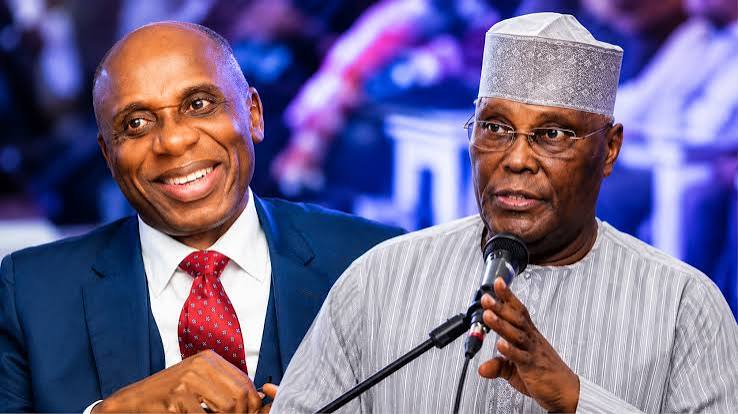
A leader may summon the finest speechwriters, commission the most elegant manifesto, and fill the air with promises of a future no one can yet interrogate. But there is one credential that cannot be outsourced or manufactured: a governing record.
That was the defining distinction the African Democratic Congress ticket of Alhaji Atiku Abubakar and Rt Hon Rotimi Amaechi brought to the 2026 Nigerian Bar Association Annual General Conference in Port Harcourt. In a Nigerian political climate awash with recycled rhetoric, consultant-crafted manifestos, and promises that evaporate once power is secured, they came armed with something far more compelling and impossible to counterfeit: a demonstrable record of governance.
The conference itself, held in the host city where Amaechi once governed, provided an almost poetic setting for this reckoning.
Here was a man standing before his peers: lawyers, jurists, and citizens of a state he once governed and had transformed being challenged not on his rhetoric but on his record.
When Omoyele Sowore accused him of building “a rail line that went nowhere,” Amaechi did not retreat into abstraction. He pointed to the Lagos-Ibadan and Abuja-Kaduna railways, to the roads and primary schools of Rivers State, and the hundreds of model schools equipped with ICT centres and libraries that his administration constructed.
He did not ask the audience to trust his vision; he asked them to verify his past. “Judge us by our achievements,” he insisted, cutting through the noise of political posturing with a demand that evidentiary standards should be the only criteria.
This is the signature of the ADC ticket: a governance philosophy anchored only on the verifiable. Amaechi’s challenge to the Nigerian electorate: “Assess us by our last performance and choose; not just vote because you are from Ikwerre or Omoku, Hausa, or Yoruba, Ijaw or Igbo.” This is not merely a campaign slogan. It is an epistemological stance, a belief that political legitimacy must be earned through documented competence rather than ethnic affinity or populist charisma.
But the NBA conference revealed something deeper than a defence of past records. It illuminated the philosophical architecture of the ADC’s approach to Nigeria’s most pressing economic question: the subsidy dilemma. While Peter Obi defended the necessity of subsidy removal, arguing that mismanagement of proceeds should not be the reason for not removing it, and while Sowore maintained his long-standing opposition to any removal, Amaechi staked out a position that was neither the shock therapy of Tinubu nor the ideological purity of the activist turn politician. “We will not remove subsidy because the poor in Nigeria need to be subsidised instead of the rich,” he declared. “We are already subsidising (the rich) them with waivers. We have a duty to return power to the people.”
This is not the language of a politician pandering to the gallery. It is the language of a man who has governed through economic cycles, who has seen the difference between subsidising productivity and subsidising consumption, and who understands that the Nigerian poor do not benefit from the abstract efficiencies of market fundamentalism.
Amaechi’s position aligns seamlessly with the Atiku Economic Recovery Plan, which proposes a production subsidy. A subsidy that follows the barrel from crude allocation through refining to the Nigerian consumer, capped, budgeted, audited, and designed to disappear as domestic production capacity grows.
It is a solution born not from the abstractions of textbook economics, but from lived experience: from a ticket whose candidates have managed the nation’s economy at the highest levels. As Chairman of the National Economic Council and as the governor of a state that rose to become Nigeria’s third-largest economy by internally generated revenue, to service as Minister of Transportation during one of the most consequential periods of infrastructure expansion in the country’s recent history.
What the interventions of the major opposition presidential candidates at the NBA Conference revealed was that the ADC ticket represents a fundamentally different category of political offering: a ticket built not on promises, but on proof; not on theory, but on an established record.
When Amaechi challenged Sowore: “Sowore, what is your experience? When politicians are talking, close your mouth”— he was asserting, however bluntly, a hierarchy of political credibility: that those who have borne the responsibility of governing must be assessed differently from those whose principal experience has been observing, criticising, or commenting from outside government.
This need not be understood as arrogance. Properly situated, it is a democratic standard. Candidates routinely offer elaborate visions they have never had the responsibility of implementing, Amaechi was effectively asking the electorate, (and, in this instance, the lawyers assembled in the room) to apply to political choice the same evidentiary rigour they would apply to a case before a court.
The question, therefore, is not simply what do you promise to do? It is also: what have you done when entrusted with power, and what evidence does that record provide that you can do it again?
And the case for the ADC ticket, when examined with this rigour, is compelling precisely because it is built on reforms that have already been demonstrated.
Atiku’s production subsidy plan is not a speculative proposal; it is an evolution of the economic management that produced 6% GDP growth, economic reforms and debt freedom. Amaechi’s infrastructure philosophy is not a campaign fantasy; it is the continuation of a transportation revolution that built over 3,200 kilometres of roads, 29 bridges as Governor, a deep seaport and multiple railway lines.
Their approach to security is not an abstract exercise in policy formulation; it is rooted in a record of practical innovation and measurable outcomes. It draws from the C4I framework deployed in Rivers State to strengthen security coordination and reduce crime, and from the Deep Blue Project, which adapted and expanded elements of that same intelligence-led C4I model to secure Nigeria’s maritime domain. The result of which was a significant improvement in maritime security, contributing to the Gulf of Guinea’s removal from its previous designation as the world’s most dangerous shipping region, negatively affecting the cost of shipping (importation and exports)
In other words, the Atiku-Amaechi security proposition is informed not by theory alone, but by systems they have helped to conceive, deploy, and test under the real pressures of governance.
What distinguishes the ADC ticket, therefore, is not merely the sum of its parts but the synergy between them. Atiku brings the macroeconomic architecture from his experience as Vice President and chairman of NEC, who played a prominent role in debt management, the privatisation expertise, the restructuring advocacy. Amaechi brings the implementation muscle: the project delivery, the inter-governmental negotiation, the capacity to translate executive power into results. Together, they offer a governance model in which policy and execution are not separate functions but integrated.
The NBA conference was, in this sense, a preview of how an ADC administration would govern: with transparency as a non-negotiable standard, with records as the basis for accountability, and with the poor as the primary beneficiaries of its economic intervention.
When Amaechi declared that “we have a duty to return power to the people,” he was not just speaking of a constitutional abstraction. He was speaking of implementing policies that protects the poor and vulnerable, the farmer, and the trader from the predations of a market rigged for the rich. When he urged Nigerians to “assess us by our last performance and choose,” he was offering a standard of democratic judgment that elevates competence over charisma, evidence over ethnicity, and achievement over aspiration.
Nigeria stands at a crossroads. The Tinubu administration has demonstrated what happens when reform is imposed without sequencing, and when the National Economic Council is reduced to a rubber stamp for presidential fiat, where policies cannot be coordinated with States.
The poverty statistics tell the story, with over 4 million additional Nigerians pushed into destitution in just 3 years, inflation over the roof, food prices beyond the reach of the average Nigerian.
The ADC alternative is not to reverse reform but to humanise it, to replace shock therapy with structured transition, and to ensure that the poor are subsidised, while being brought out of poverty, through structured intervention, “not city boys rice sharing”.
The 2027 election will not merely determine who becomes President and Vice President; it will also determine the philosophy of governance that shapes Nigeria’s future. On one side stands the politics of preponderous lies: of declaring that “subsidy is gone” while still spending over ₦20 trillion on so-called energy security and more than ₦8 trillion on under-recovery—a sophisticated name for “subsidy”–even as the most vulnerable in our society continue to suffer and the privileged few live in opulence.
On the other stands the politics of empathy: policies built on tested experience, interventions measured by their impact on the most vulnerable, and leaders who can say, with documentary evidence, “We have done this before.”
The ADC ticket, as exemplified at the NBA Conference, offers the latter. It is a ticket that asks not for blind trust, but for verification; not for faith, but to be judged by the evidence of past performance.