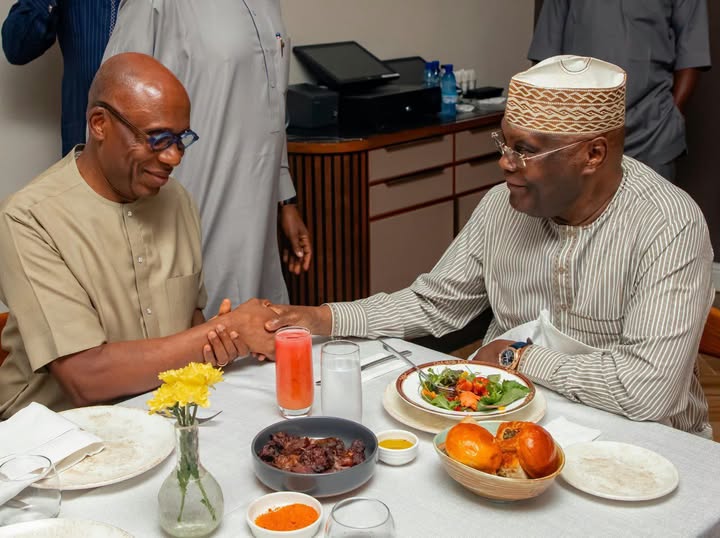
On Thursday, 27 August 2026, President Asiwaju Bola Ahmed Tinubu announced an agreement with the Governors’ Forum aimed at reducing transportation costs, anchored around the Federal Government’s ongoing Compressed Natural Gas (CNG) initiative.
The President announced plans to roll out an additional 500 CNG stations nationwide, on top of the 500 already ordered. He also announced the establishment of a Federal Government/States committee to commence the implementation of these measures across the country.
At first glance, this may appear to be a welcome development. However, several important questions remain unanswered.
It is clear to discerning Nigerians that the recent activities of the opposition African Democratic Congress (ADC), led by Alhaji Atiku Abubakar, GCON, and ably supported by Chibuike Rotimi Amaechi, CON, have unsettled the incumbent administration and its handlers. The repeated and increasingly effective appearances of the ADC Presidential Candidate and his running mate across traditional and social media have not only exposed the failures of the present administration; they have also offered Nigerians a credible alternative with practical proposals aimed at sustainably reducing the economic pressure on ordinary citizens.
One would ordinarily expect that the 500 CNG stations previously ordered would, by now, be operational or at least substantially completed. If they were, the announcement of another 500 would make considerably more sense. But if the first 500 are yet to be fully completed and put into use, when exactly should Nigerians expect to feel the impact of this new order?
More importantly, the administration says that approximately 120,000 vehicles have been converted to CNG. Even taking that figure at face value, does it not represent an infinitesimal proportion of Nigeria’s enormous commercial transportation ecosystem? And does this figure adequately distinguish between commercial vehicles and privately owned vehicles whose owners independently chose to convert to CNG?
These are not academic questions. They go to the heart of whether the administration’s intervention is capable of producing meaningful relief for millions of Nigerians who depend on public and commercial transportation every day.
The timing of this announcement is also instructive. It comes in the wake of Alhaji Atiku Abubakar’s declaration of his intention to reintroduce a form of subsidy—not at the consumption end, as was the case under the old subsidy regime, but at the production end.
Rather than engage that proposal on its merits, the response from the administration and its supporters has largely consisted of insults, name-calling and the recycling of half-baked information designed to confuse Nigerians and protect vested interests.
Yet Atiku Abubakar’s proposal represents one of the few direct interventions currently on the table that seeks to address the alarming hardship being experienced by millions of Nigerians as a consequence of the mishandling of what was once presented as the foundation for a stronger Nigerian economy.
The administration has deliberately sought to distort the proposal by presenting it as a return to the old, corruption-ridden fuel subsidy regime. That characterization is misleading.
What they have conveniently failed to tell Nigerians is that, under Alhaji Atiku Abubakar’s proposal, government would not simply be writing cheques to fuel producers. The central idea is to provide Nigerian refiners with access to domestic crude at a discounted rate, alongside import and duty waivers on specific categories of manufacturing equipment and other necessary support.