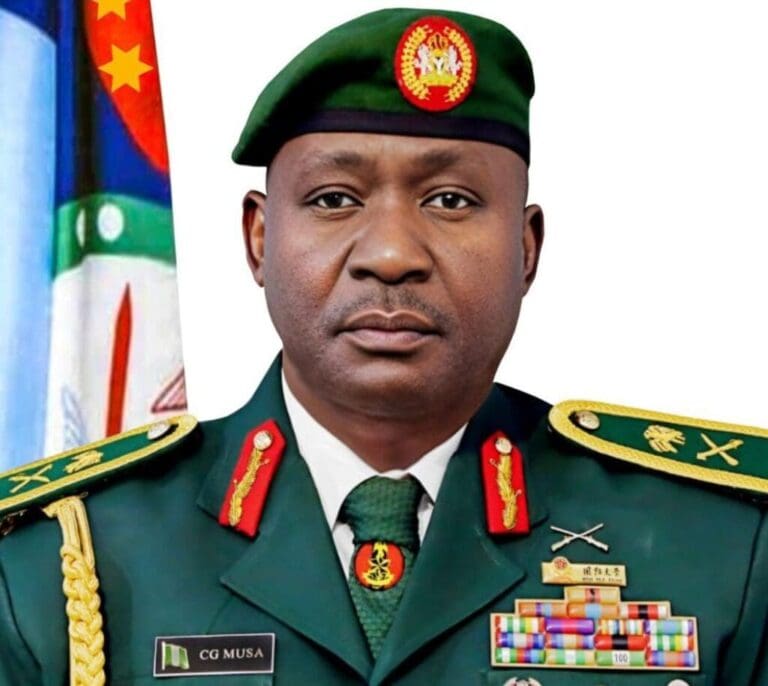
Did Gen Christopher Shield Christians From Violence In The North? A Response In Defence Of Gen Christopher Musa
By Suleiman Abubakar
Nigeria carries deep scars from years of insecurity, loss, and broken trust. In moments like these, anger and pain are understandable, and sometimes they spill over into accusations shaped by religion. Yet, if the nation must heal, our conversations must be guided by truth, balance, and calm reflection, not by narratives that widen old wounds. It is in this spirit that the allegations against General Christopher Gwabin Musa (rtd.) deserve a fair and honest response.
The airstrike incidents in Tudun Biri, Sokoto, and Zurmi were tragic and heartbreaking. Families lost loved ones, communities were thrown into mourning, and the nation was once again reminded of the heavy cost of war. The Nigerian Armed Forces officially acknowledged these incidents as operational errors, initiated investigations, issued public apologies, and began compensation processes. Sadly, such errors are not new. They have occurred before, and during General Musa’s tenure, under both Muslim and Christian service chiefs. To single out these tragedies and frame them as a religious plot is not only misleading, it risks deepening division at a time when unity is most needed. Military decisions are collective, shaped by intelligence reports, air command assessments, ground realities, and political authorisation, not by the personal faith of one individual. There has been no credible evidence to suggest that these victims were targeted because they were Muslims.
Equally important is the claim that General Musa portrayed Islam as Nigeria’s enemy. This is simply untrue. His statements on jihadist threats in the Sahel mirror the consensus of the African Union, ECOWAS, the United Nations, and security experts across the world. Talking about extremist violence does not amount to attacking Islam or Muslims. Nigeria faces multiple security challenges at the same time, from Boko Haram and ISWAP to armed banditry, criminal herder–farmer networks, and separatist violence linked to IPOB and ESN. In security briefings, leaders often focus on the threat most relevant to the context of the discussion. The absence of one issue in a speech does not mean denial or support for it. That is simply how security communication works everywhere in the world.
Claims that Christian violence was protected under General Musa’s watch also do not stand up to facts. IPOB has been formally proscribed by Nigerian courts as a terrorist organisation, and military operations against ESN and violent separatist groups continued throughout his service. Security personnel paid with their lives during operations in the Southeast, underscoring that these threats were not ignored or treated with religious favouritism. The idea that General Musa shielded any form of violence on religious grounds is not supported by evidence.
When it comes to appointments, Nigeria’s constitutional framework does not operate on religious compensation. Public offices are filled through a mix of political calculation, security needs, federal character considerations, competence, and timing. This process is far from perfect, but it is not driven by a deliberate plan to replace one religion with another. Under the same administration, Muslims and Christians alike have occupied and continue to occupy strategic positions. Selective comparisons only distort a much longer history of rotational power across different governments.
One reality that cannot be denied is that General Christopher Musa earned trust across religious and regional lines. During his years in service, he enjoyed confidence from Muslims, Christians, and traditional institutions alike. He consistently spoke about national unity, the protection of civilians, professionalism within the armed forces, and the need to keep the military above politics. His post-service appointment reflects confidence in his experience and leadership, not a conspiracy aimed at any religious group.
Nigeria’s strength does not lie in one faith overpowering another. It lies in the quiet resilience of ordinary people who continue to live together despite hardship. Muslims and Christians trade in the same markets, farm on the same land, serve in the same institutions, marry across religious lines, and protect one another in moments of danger. Turning tragedy into religious blame threatens this fragile bond and risks pushing the country further apart.
In the end, demanding accountability for military errors is legitimate, and mourning the dead while seeking justice is both human and necessary. What is not acceptable is turning shared pain into a weapon of division. General Christopher Gwabin Musa (rtd.) should be judged by verifiable actions and established facts, not by assumptions tied to his personal faith. Nigeria’s true enemies remain terrorism, misinformation, poverty, and division, not Christians or Muslims. Justice is sustained by truth, unity is preserved by restraint, and nationhood demands wisdom from us all.
Written by Suleiman Abubakar
Public affairs commentator and analyst based in Kaduna
About the Author